
Are you hesitant to implement a chatbot for your business because of the initial challenges?
As chatbots become an integral part of modern customer service, more businesses are adopting them to enhance operations and improve the customer experience. In fact, one study shows that 80% of businesses plan to use chatbots by 2025.
However, the path to successful chatbot implementation can be challenging. Many business owners hesitate due to the initial steps—such as selecting the right platform and training the AI—which requires time, effort, and careful planning. Despite these hurdles, the long-term benefits, like improved customer engagement, 24/7 support, and cost savings, are significant to any business.
In this article, we’ll explore the key challenges businesses face when implementing chatbots and why, despite the initial effort, the investment is often worth it.
How To Resolve Common Issues In Chatbot Integration?
Common Hurdle 1: Prioritizing Customer Intent
One of the most common challenges chatbots face is understanding customer intent, especially with vague, complex, or ambiguous queries. When a chatbot fails to correctly interpret what the customer is asking, it can lead to frustrating interactions and poor customer experiences.
While chatbot systems are effective for straightforward requests, they struggle to understand the nuances of natural language, especially when queries are unclear or complex. This limitation can result in the chatbot providing irrelevant or incorrect answers, which impacts user satisfaction.
Long-Term Benefit: To overcome this, businesses need to prioritize the development of chatbots that can better understand customer intent. Over time, chatbots will evolve and learn from each interaction, becoming better at handling diverse customer queries. This improvement boosts customer satisfaction and reduces the reliance on human agents for simple inquiries, leading to higher efficiency and better resource allocation.
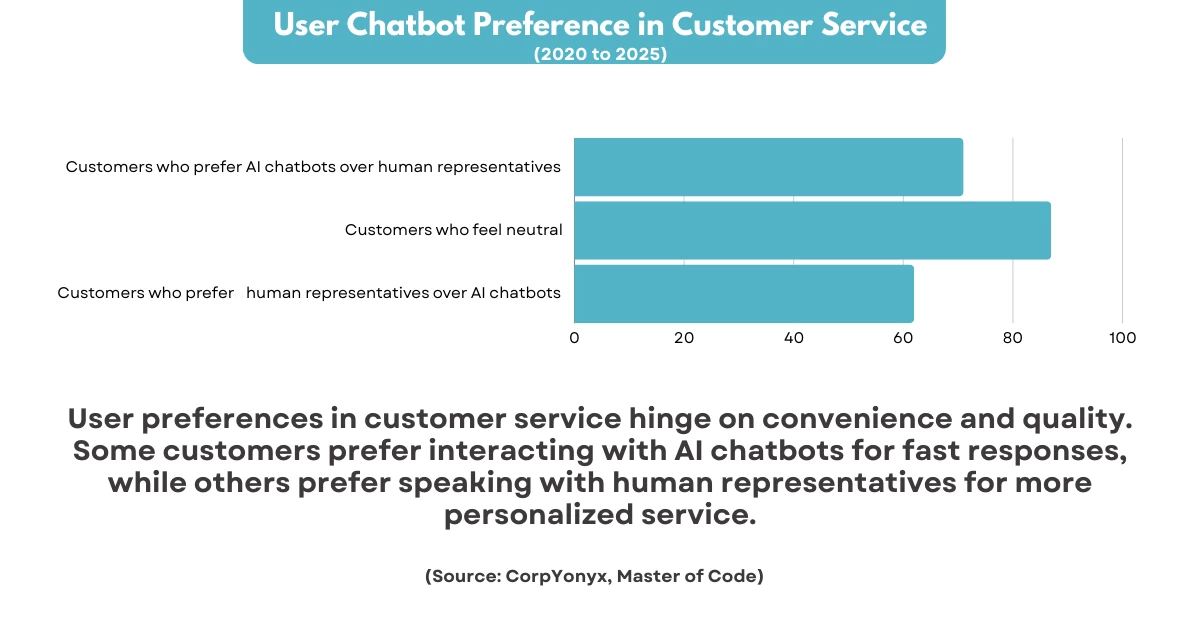
In fact, the majority of users now believe that AI chatbots are capable of taking over human customer service representatives when it comes to answering specific, straightforward inquiries.
Common Hurdle 2: Creating a Seamless Agent Takeover
While chatbots are excellent at handling routine tasks, they often struggle with complex or unique customer inquiries. Without a clear path to escalate these issues to human agents, customers may face frustration if the chatbot can't resolve their problem.
To address this challenge, businesses must design chatbots with built-in mechanisms for escalation. When the bot identifies a complex issue or receives a request beyond its capabilities, it should automatically transfer the conversation to a human agent, ensuring continuity by providing all necessary context.
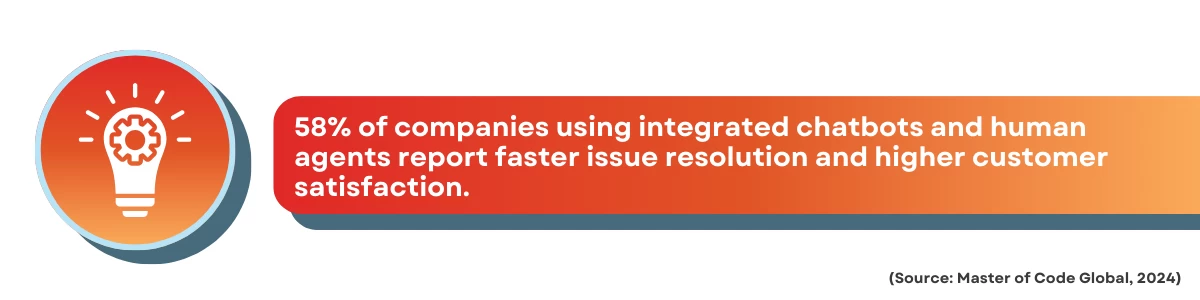
Long-Term Benefit: A seamless handoff from chatbot to human agent can significantly improve customer satisfaction. Maintaining conversation continuity and resolving issues quickly helps businesses foster better customer relationships and encourage long-term loyalty.
Common Hurdle 3: Lack of Funding/Underfunding
A common misconception when building a chatbot is that it can be done on a shoestring budget. This is likely due to the fact that chatbots are a relatively "new" technology to the general public, leading many to underestimate the costs involved and believe they can easily develop a chatbot without a significant financial investment.
The reality is that quality chatbot development requires a considerable investment, depending on the business’s scope, needs, and the expertise of the development team. While there are cheaper solutions available, they may lack the customization, sophistication, and scalability that businesses need for long-term success.
Long-Term Benefit: Proper funding is essential to build a chatbot that meets the business’s objectives and delivers value. While the upfront costs can be substantial for some, investing in a quality chatbot can yield significant returns. With proper deployment, businesses can improve operational efficiency, automate customer interactions, and increase customer satisfaction, ultimately leading to a high ROI.
Overcoming Challenges for Long-Term Success
Implementing a chatbot comes with its challenges. Budget constraints, realistic timelines, data security, and smooth transitions all require thoughtful planning and execution. Despite these hurdles, the long-term benefits—such as enhanced customer satisfaction, quicker issue resolution, and significant ROI—make the effort worthwhile. With the right tools, resources, and strategies, businesses can maximize the potential of chatbots and transform how they connect with their audience.
Ready to enhance your customer interactions affordably? Try Smicos, the AI-powered chatbot facility, for FREE! Experience smarter, faster, and more efficient customer support. Start today and see the difference!