Still wondering if using AI chatbots in your business is a safe move?
You’re not the only one.
For many, there’s still uncertainty about letting chatbots assist in high-stakes environments. Concerns over legality, accuracy, and control often take over the conversation. But here’s something worth considering: even legal courts are now using AI chatbots. In fact, they’re leading the way.
In places like India and the U.S., judicial systems have introduced AI-powered avatars and chat assistants to simplify legal communication, deliver timely updates, and improve public access to information. These aren’t test runs. They’re real tools used in real operations, proving that with the right approach, AI can meet high standards for accuracy, security, and service.
If legal courts can confidently integrate AI into their work, it’s a strong signal for businesses to explore the same.
In this article, we’ll take a look at how legal systems are applying chatbots and what that means for businesses looking to do the same.
How Legal Institutions Are Leading with AI
AI in the real world has gone far beyond hypothesis testing. We now see AI being utilized on various websites, social media platforms, and in real-life industry applications, including work tools, creative software, and the legal system.
Right now, real courts are already using chatbots and AI tools to serve citizens more efficiently. These examples show how structured, high-stakes institutions are embracing technology to improve access and communication.

Calcutta High Court, India
As part of its digital modernization efforts, the Calcutta High Court launched an AI chatbot to support legal practitioners and citizens.
- The chatbot is powered by advanced language models fine-tuned for legal text (like Pegasus)
- It uses retrieval-augmented generation (RAG) to make legal text search faster and more intuitive
- It helps users understand complex rulings through concise summaries
- It works at scale and reduces the time needed for legal research
Arizona Supreme Court, USA
In Arizona, the Supreme Court introduced AI avatars named Victoria and Daniel to bridge the communication gap during high-profile rulings.
- These avatars create explainer videos in plain language within 30 minutes
- They represent diverse voices and simplify legal jargon for the public
- They’re being expanded to civic education and broader public communication
If courts can humanize AI and make it useful for legal transparency, the same principle applies in business contexts.
AI In Courts: What This Means for Businesses
Legal systems are among the most cautious institutions when it comes to adapting innovations, especially technology revolving around artificial intelligence. However, these instances—legal courts integrating AI-powered solutions into their processes—help paint a clearer picture not just of the reputation of AI but also of the capability of its tech and how it can boost how businesses work.
AI chatbots today use similar technologies across industries:
- Large language models for human-like interaction
- Multilingual and context-aware support
- Seamless escalation to human agents when needed
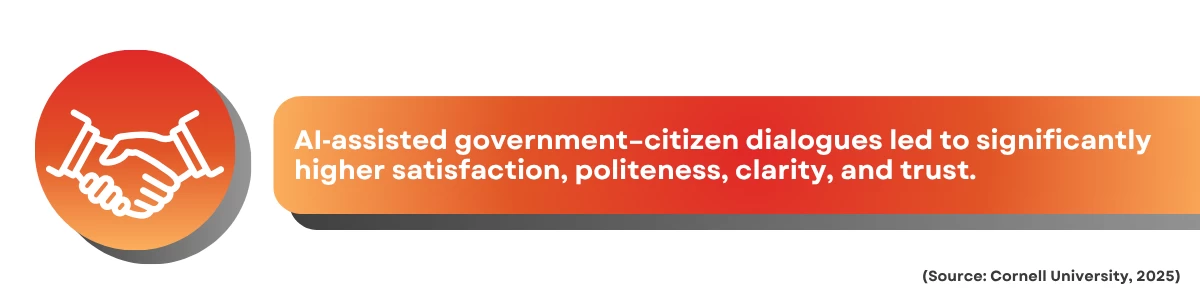
Thriving In the Local Scene: Smicos Powers DOST’s InfoSerbilis
Smicos, a Philippine-made AI chatbot facility, is already in use by the Department of Science and Technology (DOST) through its InfoSerbilis service.
- It answers public inquiries using domain-specific AI
- Supports Filipino, English, and regional dialects
- Works across websites and Facebook Messenger
- Hands off to live agents when needed
- Includes a training hub called Smicos Academy for continuous optimization
If a government agency can rely on an AI chatbot for technical services, it’s practical for private-sector use as well, whether the application is in customer support, HR, sales, or internal services.
Time to Shift Perspective
Courts and government offices are not just experimenting with AI; they’re using it to serve people better. These tools are proving useful in real-world, high-stakes environments.
The same efficiency, accessibility, and clarity can apply to your business operations. If legal institutions can use chatbots responsibly, then so can you.
Time to Shift Perspective
Courts and government agencies are already applying AI tools to serve people more effectively. These solutions are helping institutions deliver faster, clearer, and more accessible services in critical environments.
The same benefits apply to business. AI chatbots support customer engagement, streamline operations, and improve service quality. When legal institutions demonstrate the potential of responsible AI, it empowers businesses to advance confidently.
Boosting your business with AI is now easy with Smicos. Visit our website for a free demo, or book a one-on-one consultation with us to learn which Smicos features and solutions best fit your business.